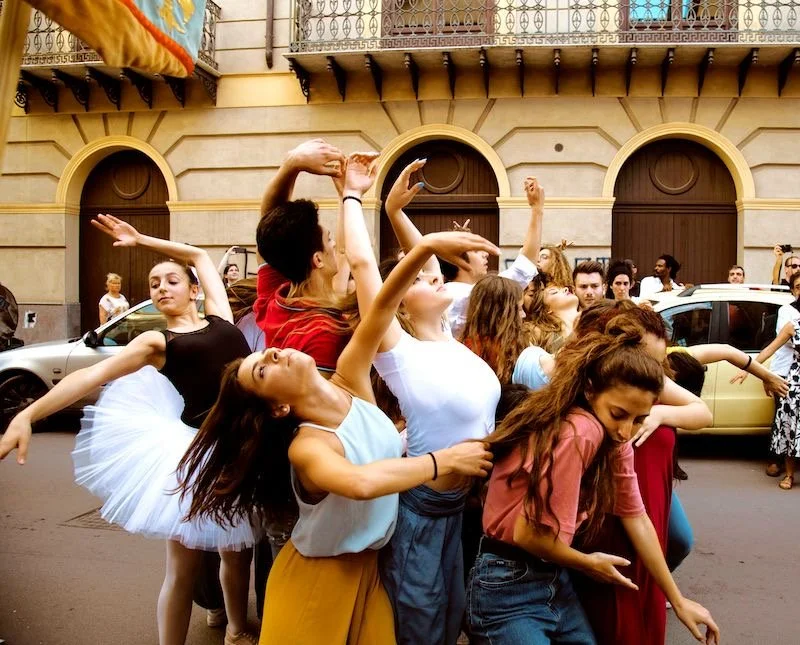
Marinella Senatore, «Palermo Procession», 2018, performance pubblica in occasione di The School of Narrative Dance, Manifesta 12, Palermo
Courtesy dell’artista e di Manifesta 12. Foto Andrea Samonà
By Vittorio Calabrese for AEA Consulting. Fourth in the series Indagine sulle strategie dei musei italiani. First published in Italian in Il Giornale dell’Arte on 15 November 2026. Read the original here.
Italian museums have never had a larger public. According to the Istat report Tra cultura e svago (April 2026), in 2025 35.8% of Italians, roughly 20 million people, visited at least one museum or exhibition, up from 22.7% in 1993. In 2024 state museums and cultural sites recorded 60.8 million entries and about 382 million euros in revenue, both record figures. These numbers measure how many people enter a museum and how much they weigh on the books. They do not say what relationship those people have with the communities that surround them. Brescia and the MACRO in Rome show how that relationship can be built through different structures and different decisions.
From public to community
The attention paid, often exclusively, to visitor counts produces partial knowledge. It describes a museum’s audience today, not its bond with a community. The distance is between visiting a museum and feeling part of it. A museum belongs to those who recognize it as their own, who return and sustain it, and to those the institution chooses to serve. This is a reciprocal recognition, and it should shape a museum’s mission, program, communication, fundraising, and access policies. A museum can also leave the question unanswered. In that case the answer is given by its history, by politics, by tourist flows and by institutional habits, and the museum becomes the museum of whoever walks by.
A museum must first of all know its public, and recognize that the composition of that public depends on its own choices about price, hours and mediation. The Censis report Musei di vetro (May 2026) identifies the main obstacles to participation: cost (47%), lack of time (28.6%), lack of interest (24.8%) and opening hours (21.3%). Price and hours are decisions of the museum. Interest is built over time, through programming and mediation. Available time is an external constraint.
Each community enters a museum’s economic model in a different way. The tourist contributes mainly through the ticket. The resident can return, subscribe, and develop a continuous relationship. The local company can support a museum it considers part of its own city. Rome made this visible. Since 2 February 2026, residents of the city and of the Città Metropolitana have had free access to the civic museum circuit, with some exhibitions ticketed separately; non-residents still pay. Free entry distinguishes two publics: residents, who already contribute through local taxation, and visitors from outside. Free entry, tickets and memberships are components of the economic model, and they say whose museum it is.
Knowing the public is not enough to give content to the word community, which appears in almost every strategic plan and social report. What remains is the institution’s role in defining how a community can take part. Marinella Senatore, who has worked for years with performance and participatory workshops across the world, proposed a distinction for this piece that applies to any organization: “There is an important distance between being invited into an institution and recognizing yourself as truly part of it.” A museum, she adds, “can multiply its devices for participation and still address the same public.”
The frame and the decisions
The Icom definition approved in Prague in 2022, at the end of a long debate that led to explicit recognition of community participation, and the Code of Ethics adopted in June 2026 place accessibility and participation at the centre. In Italy, the Livelli uniformi di qualità per i musei (2018) include relations with the territory among the evaluation criteria. It falls to each museum to translate these principles into concrete decisions.
Italian perception is far from that language. In the same Censis research, 43.1% identifies the main purpose of cultural sites as the preservation of heritage, 34.9% the transmission of knowledge, 15.3% a pleasant experience, and only 5.2% service to the community. The accounts, meanwhile, mostly reward flows. Priorities are defined in the distance between institutional language, the role the public assigns to the museum, and the criteria by which success is measured. Alex Sarian, in The Audacity of Relevance (Ecw Press, 2024), writes of a crisis of relevance from which one emerges by rediscovering a wider civic purpose and by making the effect on communities a measure of success.
These principles take shape in choices about governance, in access policies, in knowledge of the territory, and in programming. To these decisions a time factor must be added: political mandates have fixed deadlines, while building a relationship with a community takes continuity. Brescia and the MACRO in Rome show two different ways of meeting this challenge. One is a city museum system that built its answer around governance, bringing civil society into the structure. The other is a civic museum that looks for its answer beyond governance, in the daily work of direction, within constraints it does not control.
Brescia: structure and governance
In Brescia the answer lies in the institutional structure of the Civic Museums, with a solution that is still rare. In most Italian municipalities the civic museum is a department of the Administration. In 2015 the City signed a convention with Fondazione Brescia Musei for the gratuitous concession of the museum heritage, followed in 2016 by an agreement for the coordinated management of activities. The foundation, established in 2007, has 92% of its founding capital contributed by the City, with Fondazione Cab, Fondazione Asm and the Chamber of Commerce alongside.
Francesca Bazoli, President since 2018, calls the entrustment “a courageous political decision.” The City appoints four of the seven board members, including the President, chosen from civil society and serving pro bono. It sets the strategic direction and carries the political responsibility. The foundation operates with public rules and private efficiency. “This governance system,” Bazoli says, “is the precondition for everything else.” In her reading, it is what has made the foundation an institution the city recognizes as its own.
The access policies follow from there. Free entry for city residents, funded by the City and extended in some periods of the year to those living in the province, produced in 2025, according to the foundation’s figures, 34,720 entries by Brescia residents from city and province. Mondays, when the museums are closed, are reserved for associations supporting people with disabilities. 3,124 classes visited. The ambition is a museum the city uses as one service among others. The same applies to private support: the Alleanza per la Cultura brings together 52 companies and institutions in a three-year commitment to declared objectives.
The foundation also has data on where its public comes from. Of about 270,000 unique tickets issued in 2025, 13% went to residents of the city, 30% of the province, 33% of other Lombard provinces, 10% of the rest of Italy and 14% of foreign visitors. 76% of the tickets come from Lombardy, 43% from the Brescia area. This is an audience of proximity before it is an audience of flow. Rootedness shows elsewhere, in the support of the City, of local companies and of citizens.
Programming follows the same logic. Bergamo Brescia Italian Capital of Culture, in 2023, was the multiplier of 40 years of investment in the heritage. The most important legacy, according to the President, is a realization: the people of Brescia understood that they could rely on their own heritage to position the city culturally. The limit is one Bazoli herself names. The model is transferable only in part, where a living entrepreneurial or professional fabric exists and the cultural values of the community can be clearly identified. What travels beyond Brescia is the point of departure: structure before instruments, and time enough for them to bear fruit.
MACRO: beyond governance
At the scale of a single institution the structure is often a given, and the answer is decided beyond governance, in the priorities of the directorship and in its daily work. The MACRO, the museum of contemporary art of Roma Capitale, is managed by the Azienda Speciale Palaexpo. It sits outside the Musei in Comune circuit and the resident free entry scheme, to which it is linked by convention. The artistic direction, entrusted to Cristiana Perrella since 2025, operates within a more complex and less autonomous institutional setting, and still keeps room to shape programming and the relationship with the public.
Her reading starts from the city, not from the museum. “Rome needs an institution that returns to a clear role for its citizens, and from which Rome can speak to the international art system.” Her working assumption is that the city expresses a demand no one has yet taken up.
Even without authority over access policies, the direction can intervene in the museum’s relationship with the city. For Perrella the public is not only the public of exhibitions. It includes those who come for the bar, the bookshop or the study hall. This recognizes a function that goes beyond the exhibition experience. In this spirit comes the listening project, planned with Human Foundation for the museum’s 25th anniversary in 2027: street interviews and operator tables, to understand what role the MACRO plays for Rome beyond visitor counts.
In programming, Perrella chooses institutional continuity over the assertion of a new curatorial identity. The reopening in December 2025 was conceived in dialogue with the museum’s recent history and with the identity of the city. Another choice concerns the use of space and time in relation to different publics: a slow-rhythm area, which will also host the return of the collection, long unseen, and the regular visits of schools and tourists; a fast-rhythm area, with monthly programming; and common spaces for the neighbourhood, so that the museum becomes a place where different communities meet. The relationship with the public proceeds, in her words, “in concentric circles,” from the neighbourhood to the city, as far as those who think the museum does not concern them, on a horizon, 2027, longer than a season. The limit, again, is one Perrella herself names. Today the museum has no instruments to know who enters and whether they return. Coherent decisions, even within tight constraints, add up to a strategy. They move what remains in a director’s hands: programming and the knowledge of a public still to be built.
Heritage and community
The relationship between a museum and its communities is built by holding tourists and residents, protection and transmission of heritage and participation, earned revenue and public support together. That relationship is the result of choices that take form in governance, in programming, in access policies, and in the economic model. In the end, it means understanding the museum not only as a curatorial platform but as a centre for the communities that recognize it as their own, a centre that grows with them and listens to them. Sustainability does not start with new revenue. It starts with coherence of mission, public, and territory.
In Brescia, the history of the Civic Museums begins in 1826, with the discovery of the Roman bronze statue of the Vittoria alata, and continues for two centuries mostly through the donations of citizens. Bazoli reads it this way: “Over time heritage builds the community, and the community builds the heritage.” This holds beyond Brescia. It describes the only relationship in which a museum truly belongs to anyone: a community that has built a heritage, and that goes on being built by that heritage. It is a relationship of reciprocal trust, renewed in the choices of those who govern the museum and in the habit of the person who, in the Pinacoteca, stops in every day after the grocery run to look at a different painting.
First published in Italian in Il Giornale dell’Arte, 15 November 2026, under the title “Di chi è il museo? Un’indagine sul rapporto tra istituzione e comunità.” Original article: https://www.ilgiornaledellarte.com/Articolo/Di-chi-e-il-museo-Unindagine-sul-rapporto-tra-istituzione-e-comunita