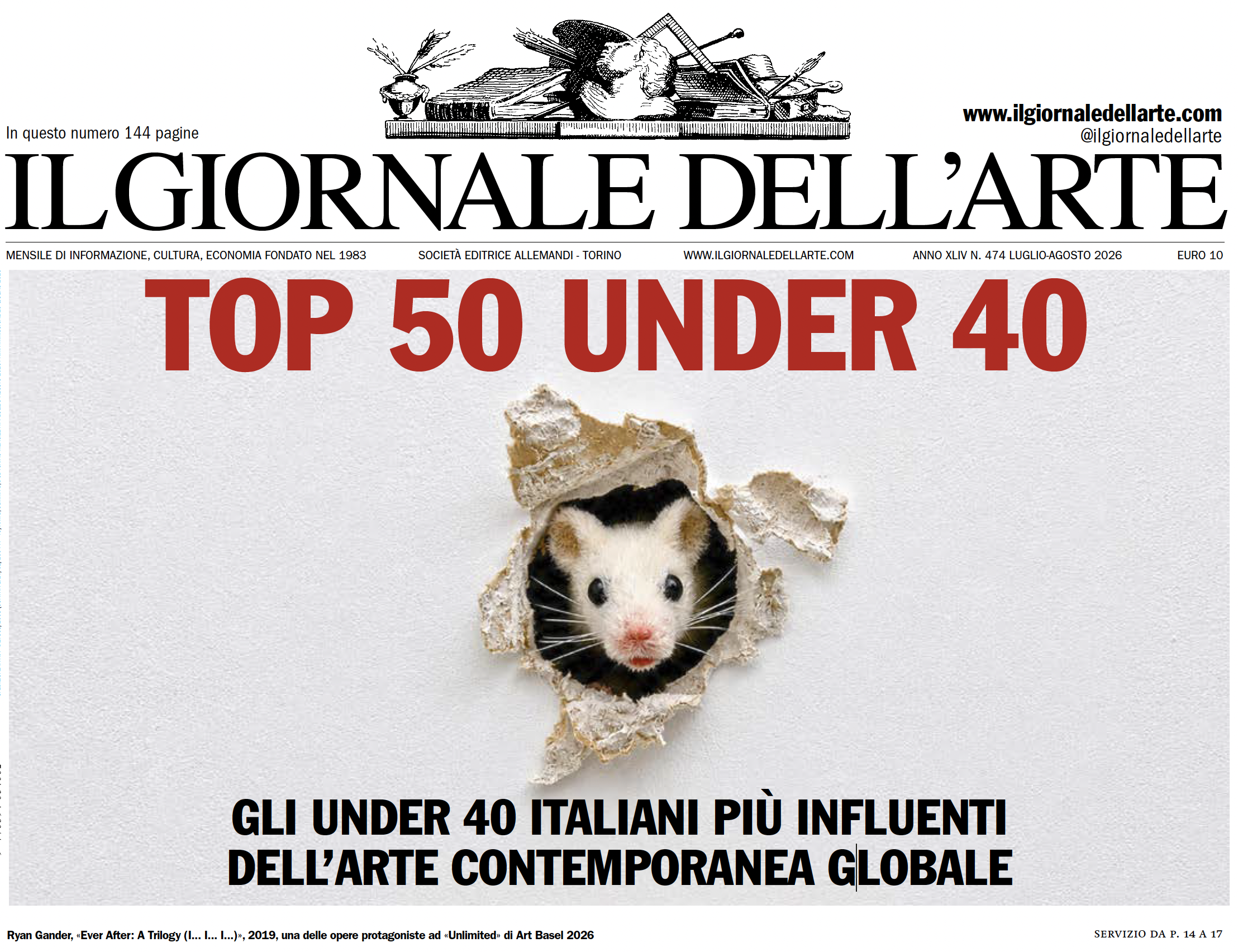
Being included in Il Giornale dell’Arte’s inaugural Top 50 Under 40 is a recognition I received with some surprise and real gratitude. The list is the paper’s editorial mapping of the fifty most influential Italian figures under forty in the contemporary art system.
What made the list interesting to read, before finding my own name on it, was its opening premise. The editors argue that influence in the art system is a subtler quantity than power, notoriety, or market value: a combination of positions, actions, ideas, visions, networks, and continuity over time. The list is alphabetical, with no ranking, and it gathers curators, museum directors, department heads at auction houses, gallerists, and heads of public and private institutions active in Italy and internationally.
The generational frame is what strikes me most. To be listed among these colleagues is a form of trust, and it says something about the moment. My generation grew up with the idea of Europe as an ordinary condition, in a world of open borders where cultural exchange is expected to be equitable and reciprocal. Formalizing a snapshot like this matters, because the map it produces orients how the next set of institutions and figures will take shape. That the initiative itself comes from Luca Zuccala, the paper’s editor-in-chief and a peer of my own generation, makes it more meaningful still: it is a generation reading its own moment, in its own voice.
The list also gives me a way to think about the shape of my own current practice. Consulting has become for me a way to inquire across the boundaries the system tends to keep separate: technology and heritage, commercial and institutional worlds, the practices of artists and the logic of the institutions that hold them. In New York, part of the work is holding a space where Italian artists arriving here and American audiences looking for a point of contact with Italy can meet. The bridges that interest me are geographic, across the Atlantic, and generational. This is the daily texture of cultural diplomacy.
Museums and cultural institutions evolve when a generation begins to hand things over. Reading this list, I keep thinking about what the next museums might look like, whose missions they will carry, and how their audiences will be shaped. What strikes me too is the deliberate breadth of the paper’s gaze: it reads Italian artists working in Italy and those active abroad as part of the same picture, in a projection into the future carried with real optimism. That, more than any recognition, is what the list makes visible.
Available in print in Il Giornale dell’Arte n.474 (July 2026).